.webp)
The Certified APIs Penetration Testing training program is designed to equip professionals with the essential skills to become proficient in Python and cybersecurity.
Through hands-on labs, real-world simulations, and cutting-edge AI-driven tools, participants will become proficient in ethical hacking techniques and critical cybersecurity practices for defending against traditional and modern AI-powered threats.

I enroll for CISM Training & Certification. All the team members of Cyber Defentech are very good & very supportive. Thank you all the team. Highly recommend for ISACA trainings and Certification. Thank you Nitish.
.webp)
.webp)
Best institute for cyber security course, I do certified ethical hacking (ceh v13) training and certificate form cyber defentech. Puja mam and Nitish sir is very supportive. I am very thankful for cyber defentech team.Any one to do any cyber security training and Certification go for cyber defentech.
.webp)
I join here for certified ethical hacking training and certification, puja mam is very supportive, faculty is to good 👍. Cyber Defentech is best for any one want to do cyber security training and certifications.👍
.webp)
I’m beyond excited to announce that I’ve officially earned my Certified Ethical Hacker (CEH) certification! by EC-Council This milestone marks a significant step in my cybersecurity journey, and I couldn’t have done it without the incredible support of Nitish Pathak, Vipin Yadav, Cyber Defentech mentorship, encouragement, and belief in me pushed me to stay focused and achieve this goal.
.webp)
I am pleased to share that I have successfully cleared the CEH Practical certification from EC-Council. I appreciate the support provided by the EC-Council proctor, who ensured a seamless exam experience. A special thank you to Nitish Pathak for facilitating access to the necessary labs and training resources, which helped in streamlining the preparation process.
.webp)
I had a great experience learning and pursuing my Certified Ethical Hacker (Practical) by EC-Council. The instructors are very helpful and I would like to recommend it to anyone who are looking to pursue their careers in Cyber Security. Thanks to Cyber Defentech for the guidance.
.webp)
I’m beyond excited to share that I have officially earned the hashtag#CertifiedEthicalHacker (Practical)certification from EC-Council. This achievement validates my hands-on skills in ethical hacking, penetration testing, and cybersecurity defense. 🛡️ A special thanks to Cyber Defentech Institute for their incredible support and guidance throughout this journey. 🙌
.webp
)
.webp)
It is my pleasure to share that I have successfully completed the Certified Ethical Hacker delivered by EC-Council . Special thanks for supporting Nitish Pathak and Cyber Defentech team for valuable support and guide.
I am pleased to share that I have successfully cleared the CEH Practical certification from EC-Council. I appreciate the support provided by the EC-Council proctor, who ensured a seamless exam experience. A special thank you to Nitish Pathak for facilitating access to the necessary labs and training resources, which helped in streamlining the preparation process.
I’m beyond excited to announce that I’ve officially earned my Certified Ethical Hacker (CEH) certification! by EC-Council This milestone marks a significant step in my cybersecurity journey, and I couldn’t have done it without the incredible support of Nitish Pathak, Vipin Yadav, Cyber Defentech mentorship, encouragement, and belief in me pushed me to stay focused and achieve this goal.

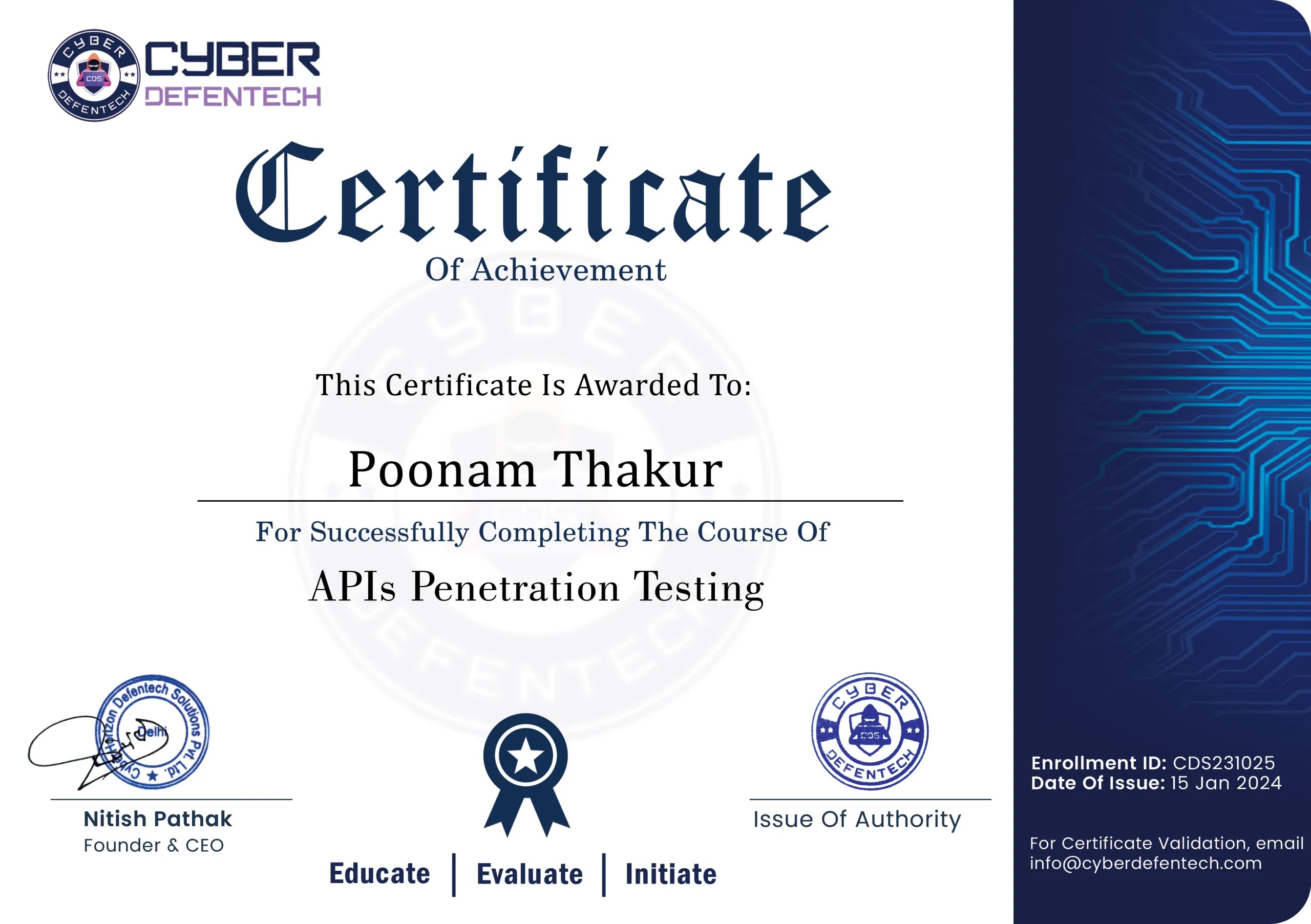
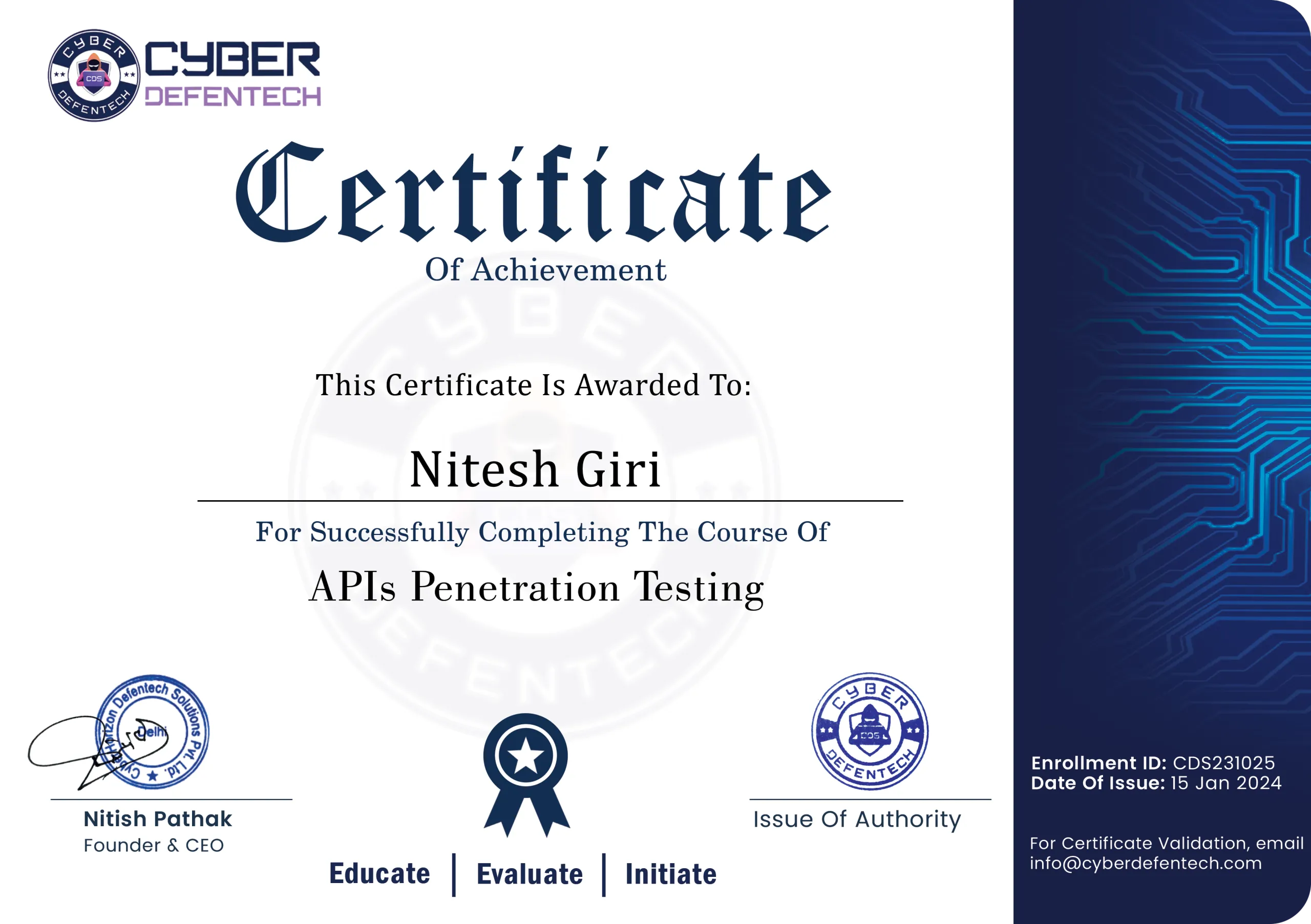
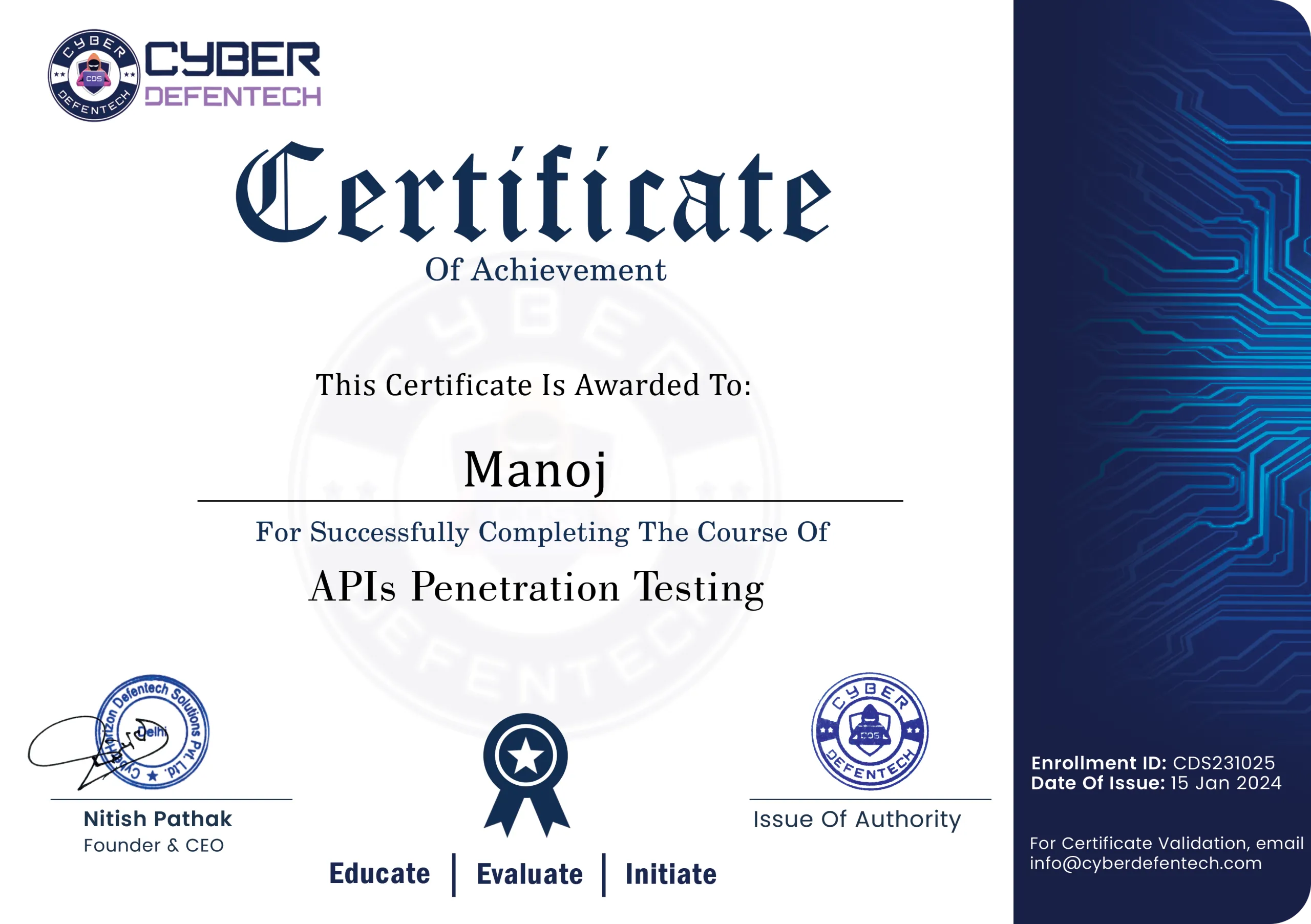
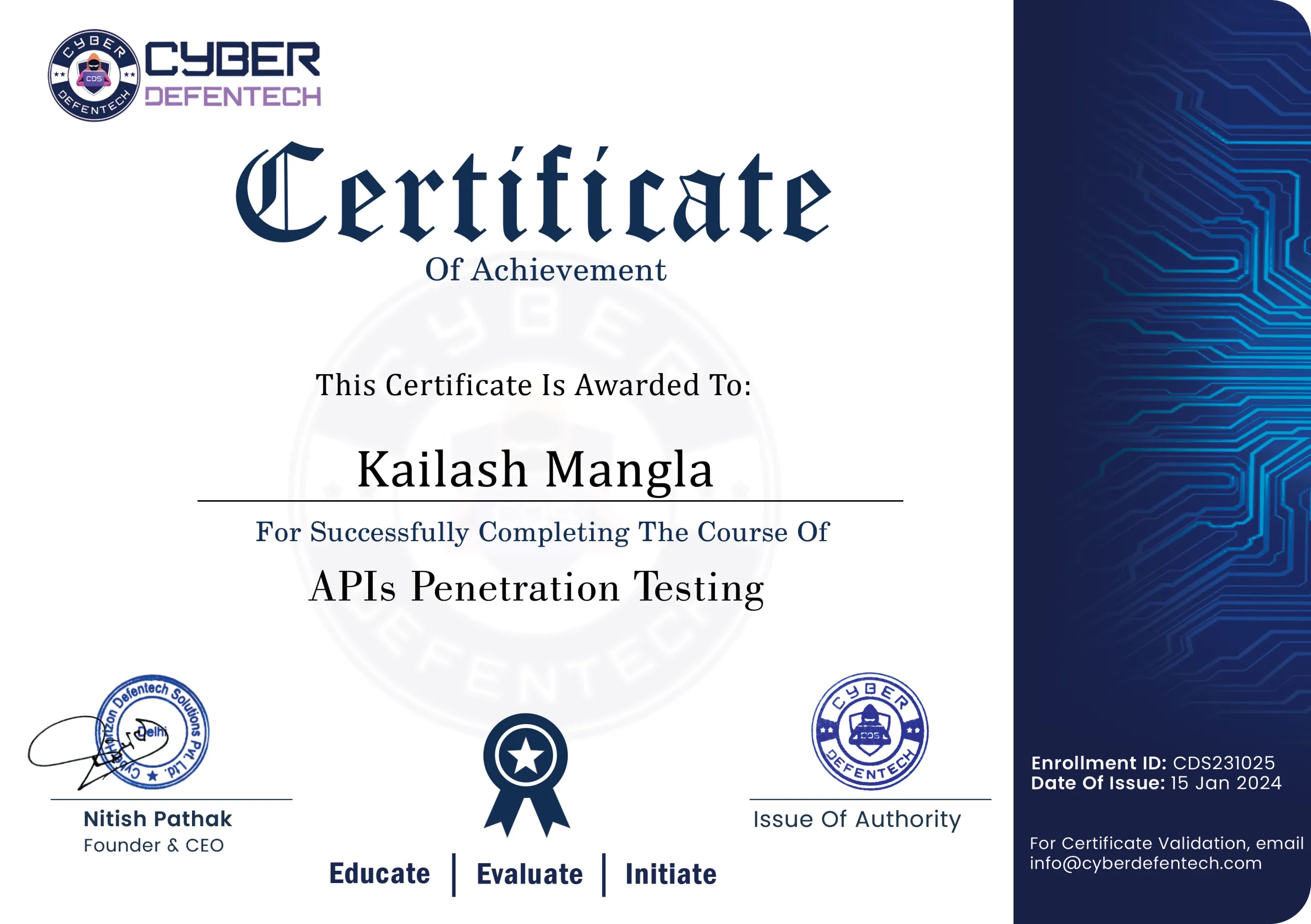




API Penetration Testing is a type of security assessment focused on identifying vulnerabilities in Application Programming Interfaces (APIs) that applications use to communicate with each other. Since APIs often handle sensitive data and critical operations, they are common targets for attackers.
✅ Prerequisites for Taking an API Penetration Testing Course After 12th Anyone who has completed their 12th standard and wants to learn API Penetration Testing should ideally have some basic understanding in the following areas: 📚 1. Basic Programming Knowledge Understanding of at least one programming language (like Python or JavaScript) Ability to read and understand JSON & XML (common API data formats) 🌐 2. Fundamental Web Concepts Basics of how websites and web servers work (HTTP/HTTPS, DNS, IP) Understanding of request-response cycles and HTTP methods (GET, POST, PUT, DELETE) 🔐 3. Introduction to Cybersecurity Basic awareness of information security, vulnerabilities, and ethical hacking Familiarity with OWASP Top 10 (especially API Top 10) 🧪 4. Familiarity with Tools (Optional but Helpful) Tools like Postman, Burp Suite, or Insomnia can be introduced early on No expert-level tool knowledge required at the start 💻 5. Willingness to Learn Strong interest in ethical hacking, cybersecurity, and testing systems Analytical mindset and curiosity to explore how systems interact
An API Penetration Testing course is designed to equip learners with the skills needed to identify and fix security weaknesses in APIs. The main goals of the course include: Understanding API Functionality: To help learners grasp how RESTful and SOAP APIs work, including authentication, data exchange formats (like JSON/XML), and API architecture. Identifying API Vulnerabilities: To train students to detect common and advanced API security issues such as broken authentication, insecure data exposure, improper access controls, rate-limiting flaws, and injection attacks. Learning Security Testing Techniques: To provide hands-on experience in analyzing and testing APIs using both manual and automated methods with tools like Postman, Burp Suite, OWASP ZAP, and others. Applying OWASP API Security Top 10: To teach how to map real-world API vulnerabilities to the OWASP API Security Top 10 framework and mitigate them effectively. Reporting and Documentation Skills: To train students in writing clear, professional vulnerability reports and providing recommendations that help developers fix the issues. Simulating Real-World Attack Scenarios: To give learners practical exposure by performing penetration tests on live or lab-based APIs, mimicking real cyberattacks ethically and legally. Promoting Secure API Development Practices: To develop awareness of best practices in secure coding and API design that prevent vulnerabilities in the first place.
An API Penetration Testing course is designed to teach how to identify, exploit, and secure vulnerabilities in Application Programming Interfaces (APIs). Below are the key topics commonly included in such a course: 🔹 1. Introduction to APIs What is an API (REST, SOAP, GraphQL) API communication formats: JSON, XML Understanding HTTP methods: GET, POST, PUT, DELETE, PATCH API lifecycle and architecture 🔹 2. Setting Up the Testing Environment Tools setup: Postman, Burp Suite, OWASP ZAP, Insomnia Setting up proxy interceptors Working with test APIs or mock APIs 🔹 3. Authentication and Authorization Testing Testing for broken authentication mechanisms Bypassing token-based security (JWT, OAuth2, API keys) Role-based access control issues (RBAC) 🔹 4. Input Validation and Injection Attacks Detecting SQL injection, command injection via API endpoints Cross-Site Scripting (XSS) in APIs Server-Side Request Forgery (SSRF) 🔹 5. OWASP API Security Top 10 In-depth coverage of each vulnerability, such as: Broken Object Level Authorization (BOLA) Broken User Authentication Excessive Data Exposure Mass Assignment Lack of Rate Limiting 🔹 6. Business Logic Testing Identifying flaws in API workflows or misuse of business rules Bypassing intended API usage to gain unauthorized access 🔹 7. Rate Limiting and DoS Testing Testing for API abuse and flood attacks Checking for lack of throttling or captcha mechanisms 🔹 8. Information Disclosure Identifying sensitive information leaks in headers, URLs, or responses Misconfigured CORS policies 🔹 9. Security Misconfigurations TLS/SSL issues Improper error handling Insecure HTTP methods enabled 🔹 10. Reporting and Remediation How to write detailed penetration test reports Remediation strategies for securing APIs Aligning with compliance standards (OWASP, GDPR, etc.) 🔹 11. Advanced Testing (Optional) GraphQL API testing API fuzzing and automation Testing mobile or IoT APIs
Yes, most API Penetration Testing courses do offer certification upon successful completion. This certification typically serves as proof that you have acquired both theoretical knowledge and hands-on skills in identifying and mitigating API vulnerabilities.
The job market for API Penetration Testing is rapidly expanding due to the explosive growth of web and mobile applications that rely heavily on APIs. As businesses move towards microservices, mobile-first apps, and cloud platforms, securing APIs has become critical, making skilled API security testers highly in demand.


 (1) (1).webp)
.webp)
.webp)




 (2).webp)

.webp)
.webp)
.webp)