.webp)
The Certified CompTIA Pentest+ training program is designed to equip professionals with the essential skills to become proficient in CompTIA Pentest+ and cybersecurity.
Through hands-on labs, real-world simulations, and cutting-edge AI-driven tools, participants will become proficient in ethical hacking techniques and critical cybersecurity practices for defending against traditional and modern AI-powered threats.
| Certification Name | CompTIA Pentest (MCQ Exam) |
|---|---|
| Exam Format | Multiple Choice Questions |
| Number of Questions | 85 Questions |
| Exam Duration | 165 Min |
| Passing Score | 720 (On a Scale of 100-900) |
| Exam Delivery | VUE / ECCEXAM |

I enroll for CISM Training & Certification. All the team members of Cyber Defentech are very good & very supportive. Thank you all the team. Highly recommend for ISACA trainings and Certification. Thank you Nitish.
.webp)
.webp)
Best institute for cyber security course, I do certified ethical hacking (ceh v13) training and certificate form cyber defentech. Puja mam and Nitish sir is very supportive. I am very thankful for cyber defentech team.Any one to do any cyber security training and Certification go for cyber defentech.
.webp)
I join here for certified ethical hacking training and certification, puja mam is very supportive, faculty is to good 👍. Cyber Defentech is best for any one want to do cyber security training and certifications.👍
.webp)
I’m beyond excited to announce that I’ve officially earned my Certified Ethical Hacker (CEH) certification! by EC-Council This milestone marks a significant step in my cybersecurity journey, and I couldn’t have done it without the incredible support of Nitish Pathak, Vipin Yadav, Cyber Defentech mentorship, encouragement, and belief in me pushed me to stay focused and achieve this goal.
.webp)
I am pleased to share that I have successfully cleared the CEH Practical certification from EC-Council. I appreciate the support provided by the EC-Council proctor, who ensured a seamless exam experience. A special thank you to Nitish Pathak for facilitating access to the necessary labs and training resources, which helped in streamlining the preparation process.
.webp)
I had a great experience learning and pursuing my Certified Ethical Hacker (Practical) by EC-Council. The instructors are very helpful and I would like to recommend it to anyone who are looking to pursue their careers in Cyber Security. Thanks to Cyber Defentech for the guidance.
.webp)
I’m beyond excited to share that I have officially earned the hashtag#CertifiedEthicalHacker (Practical)certification from EC-Council. This achievement validates my hands-on skills in ethical hacking, penetration testing, and cybersecurity defense. 🛡️ A special thanks to Cyber Defentech Institute for their incredible support and guidance throughout this journey. 🙌
.webp
)
.webp)
It is my pleasure to share that I have successfully completed the Certified Ethical Hacker delivered by EC-Council . Special thanks for supporting Nitish Pathak and Cyber Defentech team for valuable support and guide.
I am pleased to share that I have successfully cleared the CEH Practical certification from EC-Council. I appreciate the support provided by the EC-Council proctor, who ensured a seamless exam experience. A special thank you to Nitish Pathak for facilitating access to the necessary labs and training resources, which helped in streamlining the preparation process.
I’m beyond excited to announce that I’ve officially earned my Certified Ethical Hacker (CEH) certification! by EC-Council This milestone marks a significant step in my cybersecurity journey, and I couldn’t have done it without the incredible support of Nitish Pathak, Vipin Yadav, Cyber Defentech mentorship, encouragement, and belief in me pushed me to stay focused and achieve this goal.
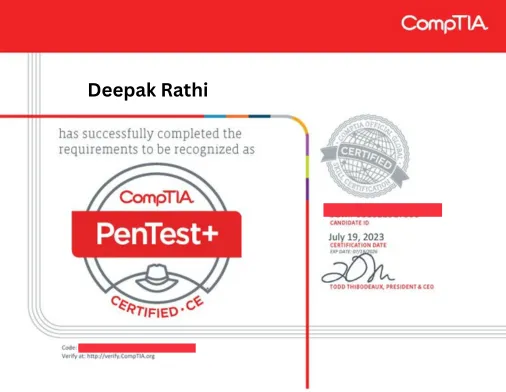




No, the CompTIA PenTest+ exam is not a hands-on practical test; it primarily consists of multiple-choice questions (MCQs) along with some performance-based items.
The CompTIA PenTest+ Certification is an excellent choice for anyone pursuing a career in penetration testing and cybersecurity. This certification can be a game-changer for aspiring professionals, opening doors to opportunities in some of the most respected organizations in the industry.
The CompTIA PenTest+ Exam is an essential certification designed to validate the skills and knowledge acquired during the CompTIA PenTest+ Training. Completing this course from a reputable and accredited institution like Cyber Defentech in Delhi ensures you're well-prepared for the exam and equipped for real-world roles in penetration testing and cybersecurity.
To understand the basic fundamentals of penetration testing, extensive coding knowledge is not a strict requirement. However, if you aim to reach an intermediate or expert level in the field, a strong command of programming and scripting languages becomes essential. Therefore, mastering coding is crucial for those looking to become expert-level professionals in today’s highly competitive penetration testing landscape.
Ethical Hacking and Penetration Testing are closely related yet distinct concepts. Their relationship can be compared to flour and cake—you can't bake a cake without flour, but flour can be used to create many other things beyond cake. Similarly, penetration testing is a specialized component of ethical hacking, focused on identifying and exploiting vulnerabilities in specific targets such as networks, applications, websites, or software. On the other hand, ethical hacking encompasses a broader range of activities beyond just penetration testing, including risk assessment, social engineering, and security auditing.

 (1) (1).webp)
.webp)
.webp)


 (2).webp)
.webp)
.webp)