The Certified Network Training program is designed to equip professionals with the essential skills to become proficient in Networking and cybersecurity.
Through hands-on labs, real-world simulations, and cutting-edge AI-driven tools, participants will become proficient in ethical hacking techniques and critical cybersecurity practices for defending against traditional and modern AI-powered threats.

I enroll for CISM Training & Certification. All the team members of Cyber Defentech are very good & very supportive. Thank you all the team. Highly recommend for ISACA trainings and Certification. Thank you Nitish.
.webp)
.webp)
Best institute for cyber security course, I do certified ethical hacking (ceh v13) training and certificate form cyber defentech. Puja mam and Nitish sir is very supportive. I am very thankful for cyber defentech team.Any one to do any cyber security training and Certification go for cyber defentech.
.webp)
I join here for certified ethical hacking training and certification, puja mam is very supportive, faculty is to good 👍. Cyber Defentech is best for any one want to do cyber security training and certifications.👍
.webp)
I’m beyond excited to announce that I’ve officially earned my Certified Ethical Hacker (CEH) certification! by EC-Council This milestone marks a significant step in my cybersecurity journey, and I couldn’t have done it without the incredible support of Nitish Pathak, Vipin Yadav, Cyber Defentech mentorship, encouragement, and belief in me pushed me to stay focused and achieve this goal.
.webp)
I am pleased to share that I have successfully cleared the CEH Practical certification from EC-Council. I appreciate the support provided by the EC-Council proctor, who ensured a seamless exam experience. A special thank you to Nitish Pathak for facilitating access to the necessary labs and training resources, which helped in streamlining the preparation process.
.webp)
I had a great experience learning and pursuing my Certified Ethical Hacker (Practical) by EC-Council. The instructors are very helpful and I would like to recommend it to anyone who are looking to pursue their careers in Cyber Security. Thanks to Cyber Defentech for the guidance.
.webp)
I’m beyond excited to share that I have officially earned the hashtag#CertifiedEthicalHacker (Practical)certification from EC-Council. This achievement validates my hands-on skills in ethical hacking, penetration testing, and cybersecurity defense. 🛡️ A special thanks to Cyber Defentech Institute for their incredible support and guidance throughout this journey. 🙌
.webp
)
.webp)
It is my pleasure to share that I have successfully completed the Certified Ethical Hacker delivered by EC-Council . Special thanks for supporting Nitish Pathak and Cyber Defentech team for valuable support and guide.
I am pleased to share that I have successfully cleared the CEH Practical certification from EC-Council. I appreciate the support provided by the EC-Council proctor, who ensured a seamless exam experience. A special thank you to Nitish Pathak for facilitating access to the necessary labs and training resources, which helped in streamlining the preparation process.
I’m beyond excited to announce that I’ve officially earned my Certified Ethical Hacker (CEH) certification! by EC-Council This milestone marks a significant step in my cybersecurity journey, and I couldn’t have done it without the incredible support of Nitish Pathak, Vipin Yadav, Cyber Defentech mentorship, encouragement, and belief in me pushed me to stay focused and achieve this goal.


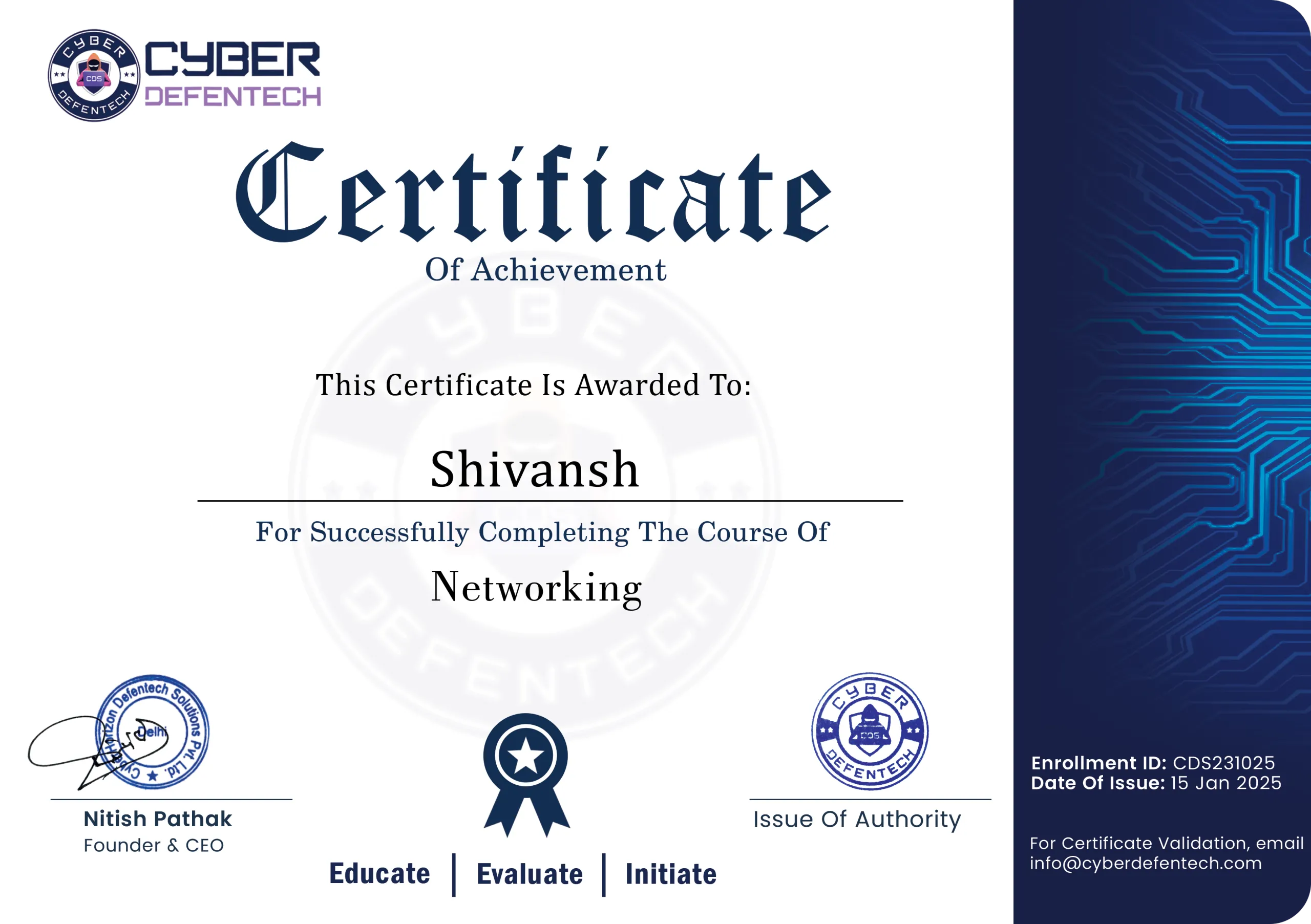
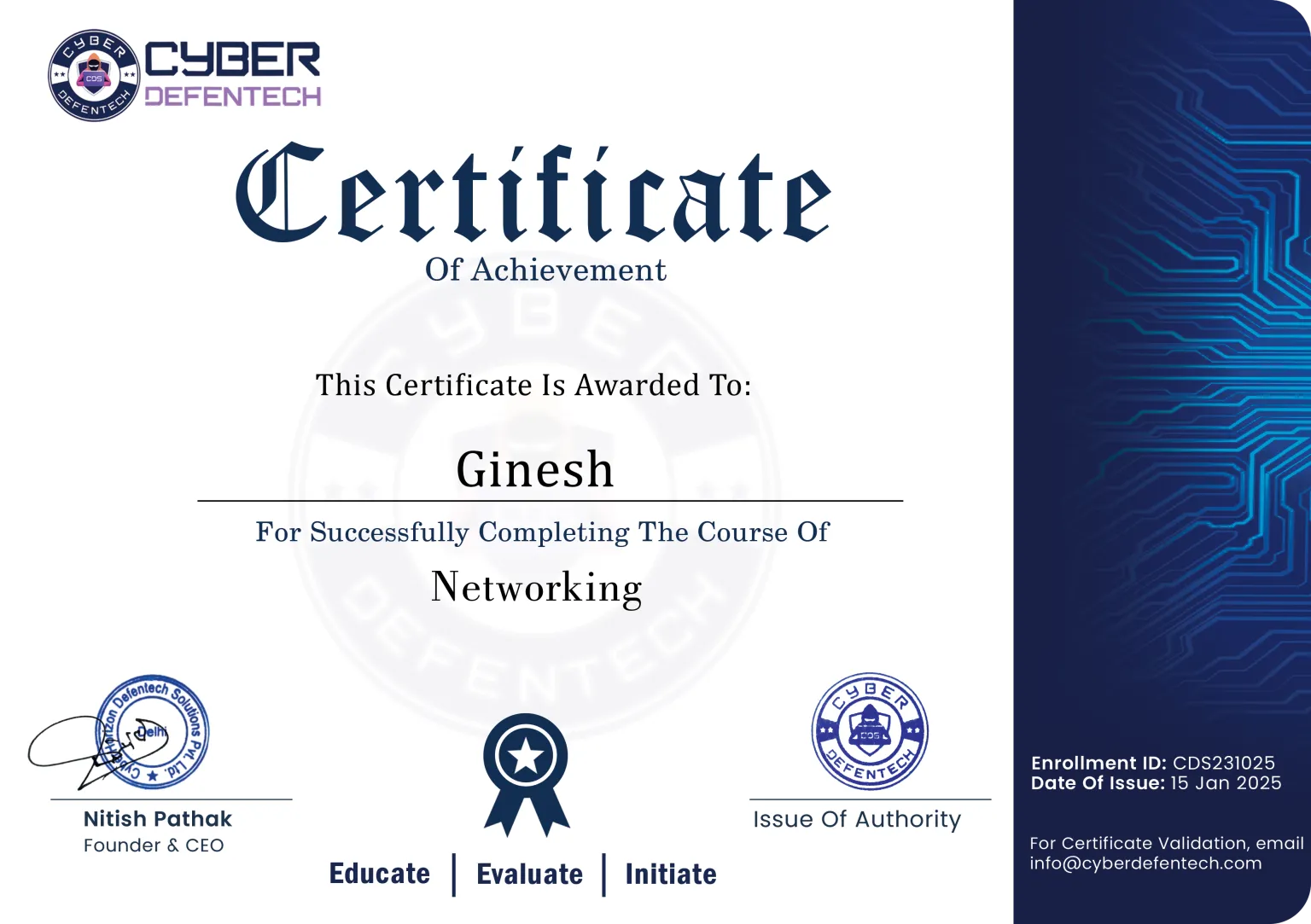
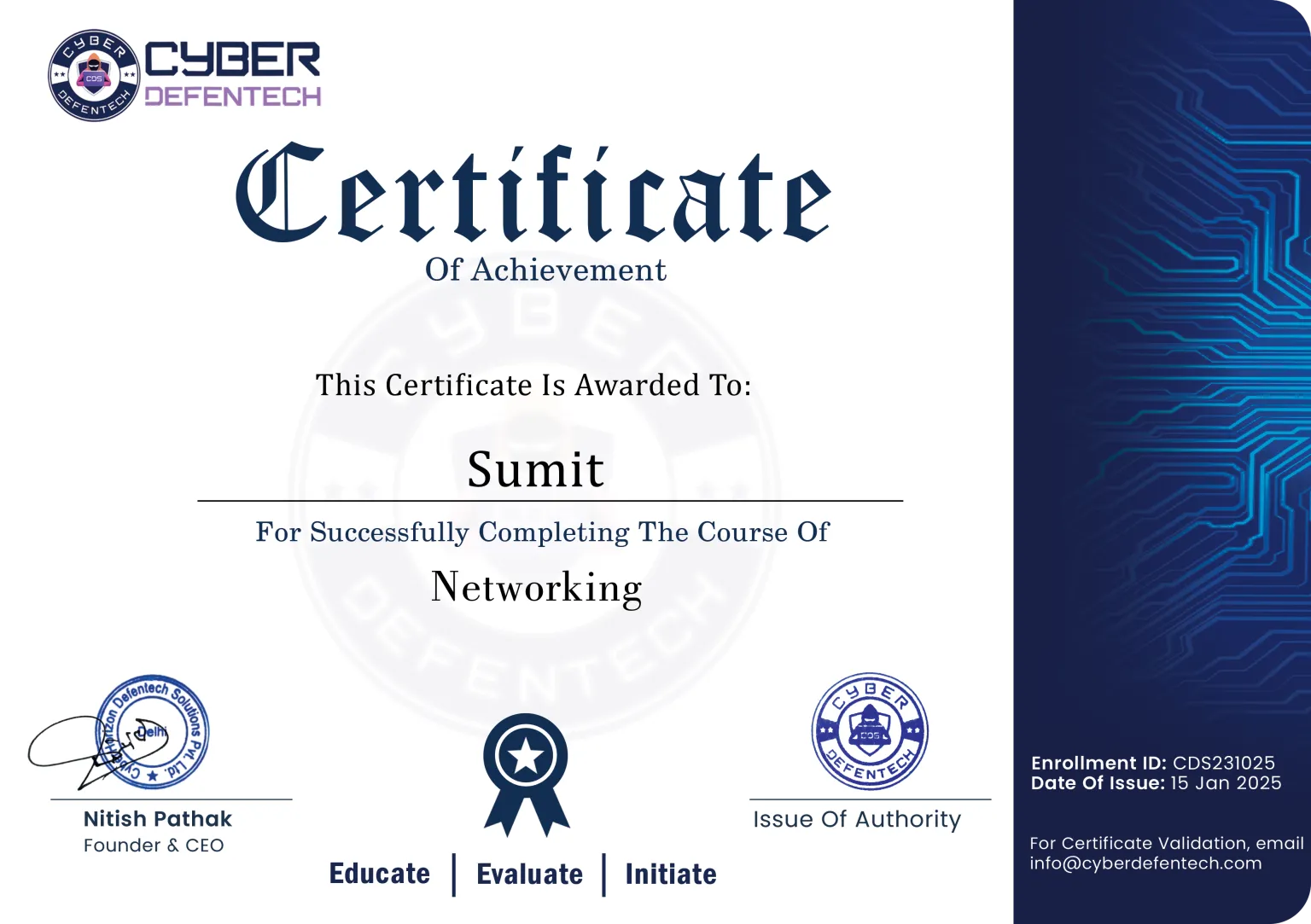
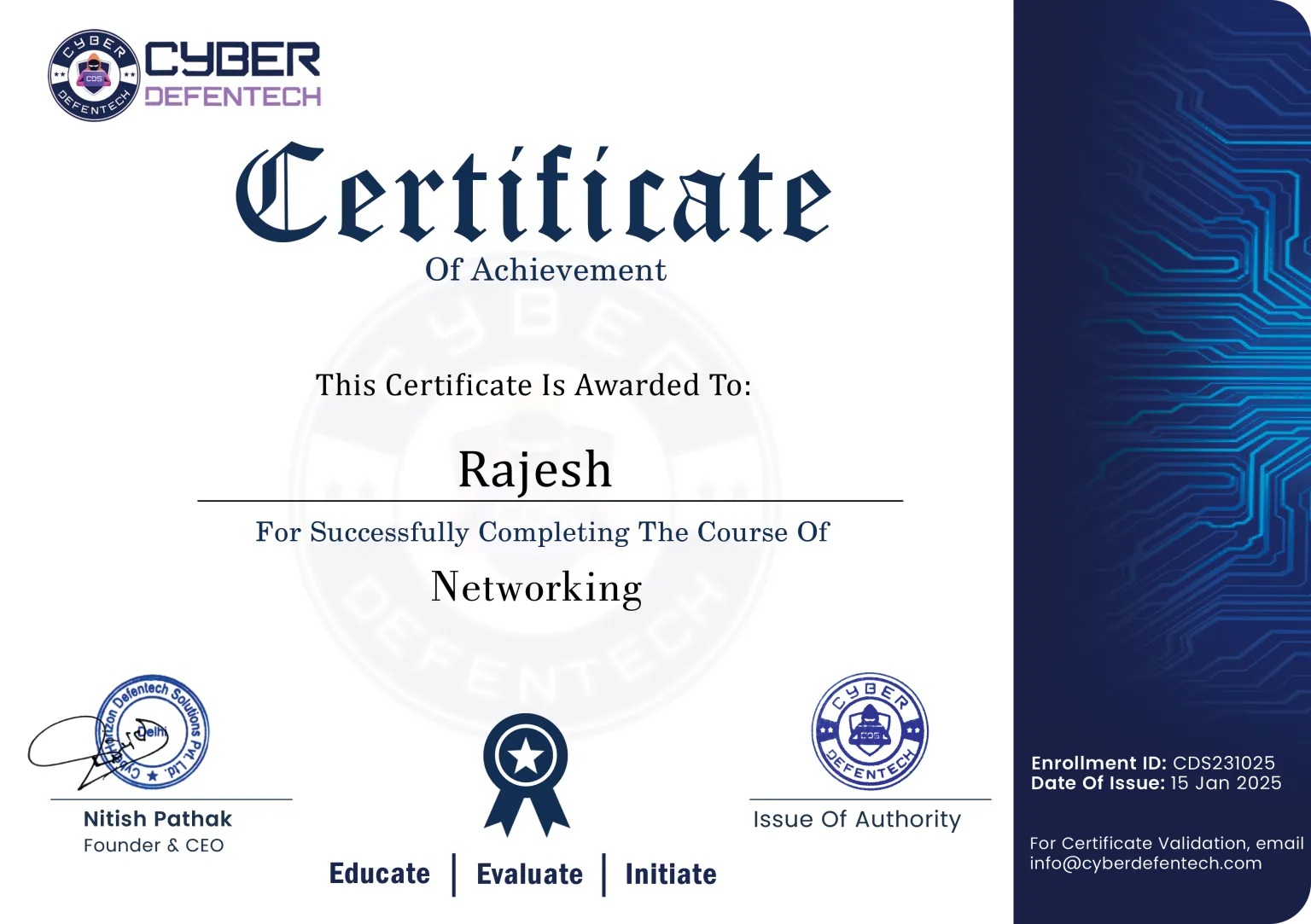




Networking refers to the practice of connecting computers, servers, and other devices together to share resources, exchange data, and enable communication. These connections can be made using physical cables (wired networks) or wireless signals (Wi-Fi). In simple terms, networking allows devices to talk to each other — whether it's sharing files, accessing the internet, printing from a shared printer, or communicating through emails and application.
Completed 10+2 (Higher Secondary) from a recognized board (any stream — Science, Commerce, Arts). However, Science stream with Physics, Mathematics, and Computer Science is preferred for better understanding. Basic computer knowledge is highly recommended (e.g., MS Office, operating system internet usage
The objectives of a networking course are to help learners gain a strong understanding of how computer networks function. The course is designed to teach the basic concepts of networking, including how devices communicate, the role of network hardware, and common networking protocols. Students also learn how to configure and manage networks, assign IP addresses, and troubleshoot technical issues. Additionally, the course aims to introduce essential tools and techniques used to keep networks secure. By the end, learners should be equipped with the practical skills and knowledge needed to work with modern networks and prepare for industry-recognized certifications.
Topics Covered in a Networking Course 1. Introduction to Networking What is a network? Types of networks: LAN, WAN, MAN, PAN Client-server vs peer-to-peer models 2. Network Models OSI Model (7 Layers): Explanation and functions of each layer TCP/IP Model: Practical implementation of networking 3. Network Devices Router, Switch, Hub, Modem, Access Point, Repeater Network Interface Cards (NICs) and Cables (UTP, STP, fiber) 4. IP Addressing and Subnetting IPv4 and IPv6 Classes of IP addresses Subnetting and supernetting DHCP (Dynamic Host Configuration Protocol) 5. Network Topologies Star, Bus, Ring, Mesh, Hybrid Advantages and disadvantages of each topology 6. Networking Protocols TCP/UDP, HTTP/HTTPS, FTP, DNS, SMTP, POP3, SNMP ARP, ICMP, NAT, VPN basics 7. Routing and Switching Static and Dynamic Routing RIP, OSPF, EIGRP (for advanced courses) VLANs (Virtual LANs) and Inter-VLAN Routing MAC addresses and Layer 2 switching 8. Wireless Networking Wi-Fi standards (802.11a/b/g/n/ac/ax) Wireless security (WEP, WPA, WPA2, WPA3) Configuration of access points and wireless routers 9. Network Security Basics Common threats: Malware, DoS/DDoS, Phishing Use of firewalls, antivirus, encryption, access control Introduction to network monitoring tools 10. Network Configuration and Troubleshooting Commands: ping, tracert, ipconfig, netstat, nslookup Troubleshooting steps and diagnostics Hands-on with simulators: Cisco Packet Tracer, GNS3 11. Network Management and Monitoring Bandwidth management Network performance analysis SNMP and network monitoring tools 12. Introduction to Cloud & Virtual Networks (Optional/Advanced) Basic concepts of cloud networking
Yes, certification is often available after completing a Networking course, and it plays a key role in validating your knowledge and skills in the IT and networking industry.
Current Job Market Overview for Networking Professionals: High Demand Across Industries Companies in IT, finance, healthcare, education, government, and telecom need networking professionals. The rise of cloud computing, remote work, cybersecurity, and IoT (Internet of Things) is creating more job opportunities. Global Demand Countries like the USA, Canada, UK, Germany, Australia, and Gulf nations actively hire certified network engineers and administrators.



 (1) (1).webp)
.webp)
.webp)






 (2).webp)

.webp)
.webp)
.webp)