.webp)
The Certified Oracle Cloud Infrastructure Architect Associate Course Overview is designed to equip professionals with the essential skills to become proficient in Oracle Cloud Infrastructure Architect Associate Course Overview and cybersecurity.
Through hands-on labs, real-world simulations, and cutting-edge AI-driven tools, participants will become proficient in ethical hacking techniques and critical cybersecurity practices for defending against traditional and modern AI-powered threats.

I enroll for CISM Training & Certification. All the team members of Cyber Defentech are very good & very supportive. Thank you all the team. Highly recommend for ISACA trainings and Certification. Thank you Nitish.
.webp)
.webp)
Best institute for cyber security course, I do certified ethical hacking (ceh v13) training and certificate form cyber defentech. Puja mam and Nitish sir is very supportive. I am very thankful for cyber defentech team.Any one to do any cyber security training and Certification go for cyber defentech.
.webp)
I join here for certified ethical hacking training and certification, puja mam is very supportive, faculty is to good 👍. Cyber Defentech is best for any one want to do cyber security training and certifications.👍
.webp)
I’m beyond excited to announce that I’ve officially earned my Certified Ethical Hacker (CEH) certification! by EC-Council This milestone marks a significant step in my cybersecurity journey, and I couldn’t have done it without the incredible support of Nitish Pathak, Vipin Yadav, Cyber Defentech mentorship, encouragement, and belief in me pushed me to stay focused and achieve this goal.
.webp)
I am pleased to share that I have successfully cleared the CEH Practical certification from EC-Council. I appreciate the support provided by the EC-Council proctor, who ensured a seamless exam experience. A special thank you to Nitish Pathak for facilitating access to the necessary labs and training resources, which helped in streamlining the preparation process.
.webp)
I had a great experience learning and pursuing my Certified Ethical Hacker (Practical) by EC-Council. The instructors are very helpful and I would like to recommend it to anyone who are looking to pursue their careers in Cyber Security. Thanks to Cyber Defentech for the guidance.
.webp)
I’m beyond excited to share that I have officially earned the hashtag#CertifiedEthicalHacker (Practical)certification from EC-Council. This achievement validates my hands-on skills in ethical hacking, penetration testing, and cybersecurity defense. 🛡️ A special thanks to Cyber Defentech Institute for their incredible support and guidance throughout this journey. 🙌
.webp
)
.webp)
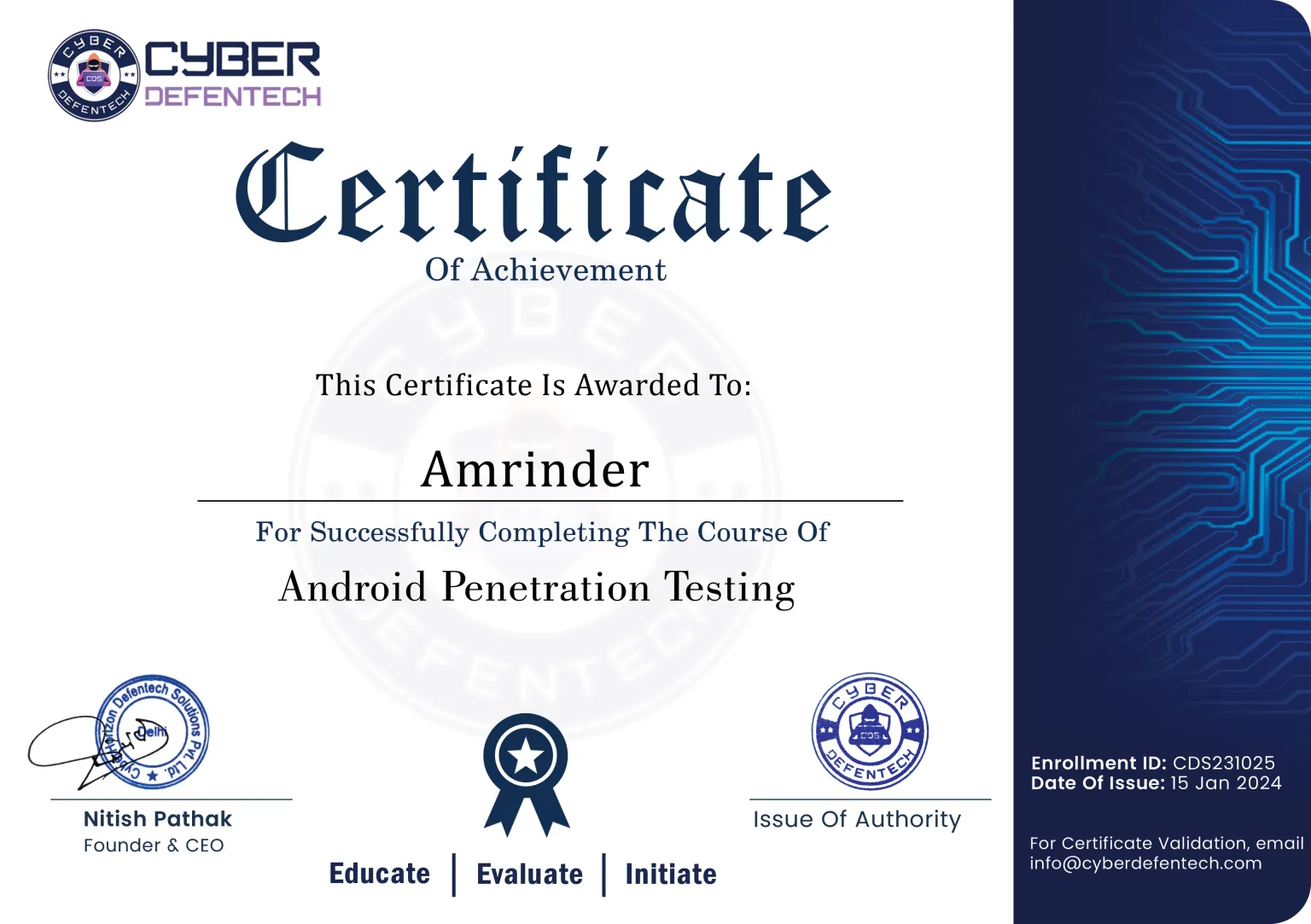
It is my pleasure to share that I have successfully completed the Certified Ethical Hacker delivered by EC-Council . Special thanks for supporting Nitish Pathak and Cyber Defentech team for valuable support and guide.
I am pleased to share that I have successfully cleared the CEH Practical certification from EC-Council. I appreciate the support provided by the EC-Council proctor, who ensured a seamless exam experience. A special thank you to Nitish Pathak for facilitating access to the necessary labs and training resources, which helped in streamlining the preparation process.
I’m beyond excited to announce that I’ve officially earned my Certified Ethical Hacker (CEH) certification! by EC-Council This milestone marks a significant step in my cybersecurity journey, and I couldn’t have done it without the incredible support of Nitish Pathak, Vipin Yadav, Cyber Defentech mentorship, encouragement, and belief in me pushed me to stay focused and achieve this goal.





The Oracle Cloud Infrastructure (OCI) Architect Associate course is designed to help learners gain a solid understanding of how to design, implement, and manage Oracle Cloud solutions. This course focuses on the fundamental architecture, services, and best practices for deploying secure and scalable cloud infrastructure on Oracle Cloud.
There are no strict prerequisites for this course, but having some foundational knowledge will help students understand the concepts more easily. Since you’re taking it after 12th, here’s what’s recommended: Educational Qualification: Completion of 10+2 (any stream) from a recognized board. Students from the Science or Commerce stream with Computer Science or Mathematics subjects have an advantage. Basic IT Knowledge: Familiarity with computer fundamentals, operating systems, and basic networking concepts. Understanding how the internet and cloud services work (like storage, databases, or virtualization). Recommended Skills (Not Mandatory): Basic knowledge of cloud computing concepts such as IaaS, PaaS, and SaaS. Familiarity with any cloud platform (like AWS, Azure, or Google Cloud) helps but is not required. Analytical and problem-solving skills for designing solutions. Optional (for better understanding): Some exposure to Linux/Windows server environments. Knowledge of databases or virtual machines is a plus.
Objectives of the Oracle Cloud Infrastructure (OCI) Architect Associate Course: The Oracle Cloud Infrastructure Architect Associate course is designed to equip learners with the knowledge and skills required to design, implement, and manage Oracle Cloud Infrastructure solutions effectively. It focuses on developing a deep understanding of OCI’s architecture, core services, and best practices for secure and optimized cloud deployments.
1. Introduction to Oracle Cloud Infrastructure (OCI) Overview of Oracle Cloud services and global infrastructure OCI data center design: regions, availability domains (ADs), and fault domains (FDs) Shared responsibility model in OCI 2. Identity and Access Management (IAM) Users, groups, policies, and compartments Managing roles and permissions Security principles and OCI IAM best practices Federation and Single Sign-On (SSO) integration 3. Core Compute Services Creating and managing compute instances Shapes, images, and boot volumes Instance configurations and pools Scaling compute resources 4. Networking in OCI Virtual Cloud Networks (VCN) Subnets (public and private) Internet, NAT, Service, and Dynamic Routing Gateways (DRG) Route tables and security lists Network Security Groups (NSGs) and firewalls Hybrid connectivity: FastConnect and VPN Connect 5. Storage Services Object storage and archival storage Block volume and file storage systems Data replication and backup strategies Storage performance tuning and lifecycle management 6. Database Services Autonomous Database (ADB) Oracle Database Cloud Service Exadata Cloud Service and Bare Metal DB Systems Backup, restore, and high-availability configurations 7. Load Balancing and High Availability Load balancer setup and traffic distribution Fault-tolerant and highly available architectures Disaster Recovery (DR) solutions in OCI Multi-region deployment strategies 8. Monitoring, Logging, and Automation OCI Monitoring, Alarms, and Logging services Resource Manager and Terraform integration OCI Events, Notifications, and Functions Automating infrastructure management 9. Security and Compliance Data encryption (at rest and in transit) Key Management (Vault service) Security zones and cloud guard implementation Compliance standards and best practices 10. Cost Management and Governance OCI pricing model and cost analysis tools Budgets and quotas Tagging and tracking cloud resources Governance frameworks 11. OCI Design and Best Practices Designing scalable, resilient, and secure architectures Multi-tier application deployment Network isolation and secure access patterns Reference architectures for enterprise workloads 12. Exam Preparation and Hands-on Labs Real-world OCI configuration scenarios Practice questions for Oracle 1Z0-1072 certification Use-case projects and architecture labs
Yes — certification is available after completing a course like the Oracle Cloud Infrastructure Architect Associate (1Z0‑1072).
🌐 1. Global Demand and Adoption Oracle Cloud is one of the top 4 global cloud providers, alongside AWS, Microsoft Azure, and Google Cloud. Many large organizations, especially in banking, healthcare, telecom, and manufacturing, rely on Oracle Cloud for critical workloads and databases. With this growth, there’s a strong demand for professionals skilled in OCI architecture, deployment, and management.



 (1) (1).webp)
.webp)
.webp)




 (2).webp)

.webp)
.webp)