The Certified Oracle Exadata Database Machine: Implementation and Administration Course Overview is designed to equip professionals with the essential skills to become proficient in Oracle Exadata Database Machine: Implementation and Administration Course Overview and cybersecurity.
Through hands-on labs, real-world simulations, and cutting-edge AI-driven tools, participants will become proficient in ethical hacking techniques and critical cybersecurity practices for defending against traditional and modern AI-powered threats.

I enroll for CISM Training & Certification. All the team members of Cyber Defentech are very good & very supportive. Thank you all the team. Highly recommend for ISACA trainings and Certification. Thank you Nitish.
.webp)
.webp)
Best institute for cyber security course, I do certified ethical hacking (ceh v13) training and certificate form cyber defentech. Puja mam and Nitish sir is very supportive. I am very thankful for cyber defentech team.Any one to do any cyber security training and Certification go for cyber defentech.
.webp)
I join here for certified ethical hacking training and certification, puja mam is very supportive, faculty is to good 👍. Cyber Defentech is best for any one want to do cyber security training and certifications.👍
.webp)
I’m beyond excited to announce that I’ve officially earned my Certified Ethical Hacker (CEH) certification! by EC-Council This milestone marks a significant step in my cybersecurity journey, and I couldn’t have done it without the incredible support of Nitish Pathak, Vipin Yadav, Cyber Defentech mentorship, encouragement, and belief in me pushed me to stay focused and achieve this goal.
.webp)
I am pleased to share that I have successfully cleared the CEH Practical certification from EC-Council. I appreciate the support provided by the EC-Council proctor, who ensured a seamless exam experience. A special thank you to Nitish Pathak for facilitating access to the necessary labs and training resources, which helped in streamlining the preparation process.
.webp)
I had a great experience learning and pursuing my Certified Ethical Hacker (Practical) by EC-Council. The instructors are very helpful and I would like to recommend it to anyone who are looking to pursue their careers in Cyber Security. Thanks to Cyber Defentech for the guidance.
.webp)
I’m beyond excited to share that I have officially earned the hashtag#CertifiedEthicalHacker (Practical)certification from EC-Council. This achievement validates my hands-on skills in ethical hacking, penetration testing, and cybersecurity defense. 🛡️ A special thanks to Cyber Defentech Institute for their incredible support and guidance throughout this journey. 🙌
.webp
)
.webp)
It is my pleasure to share that I have successfully completed the Certified Ethical Hacker delivered by EC-Council . Special thanks for supporting Nitish Pathak and Cyber Defentech team for valuable support and guide.
I am pleased to share that I have successfully cleared the CEH Practical certification from EC-Council. I appreciate the support provided by the EC-Council proctor, who ensured a seamless exam experience. A special thank you to Nitish Pathak for facilitating access to the necessary labs and training resources, which helped in streamlining the preparation process.
I’m beyond excited to announce that I’ve officially earned my Certified Ethical Hacker (CEH) certification! by EC-Council This milestone marks a significant step in my cybersecurity journey, and I couldn’t have done it without the incredible support of Nitish Pathak, Vipin Yadav, Cyber Defentech mentorship, encouragement, and belief in me pushed me to stay focused and achieve this goal.

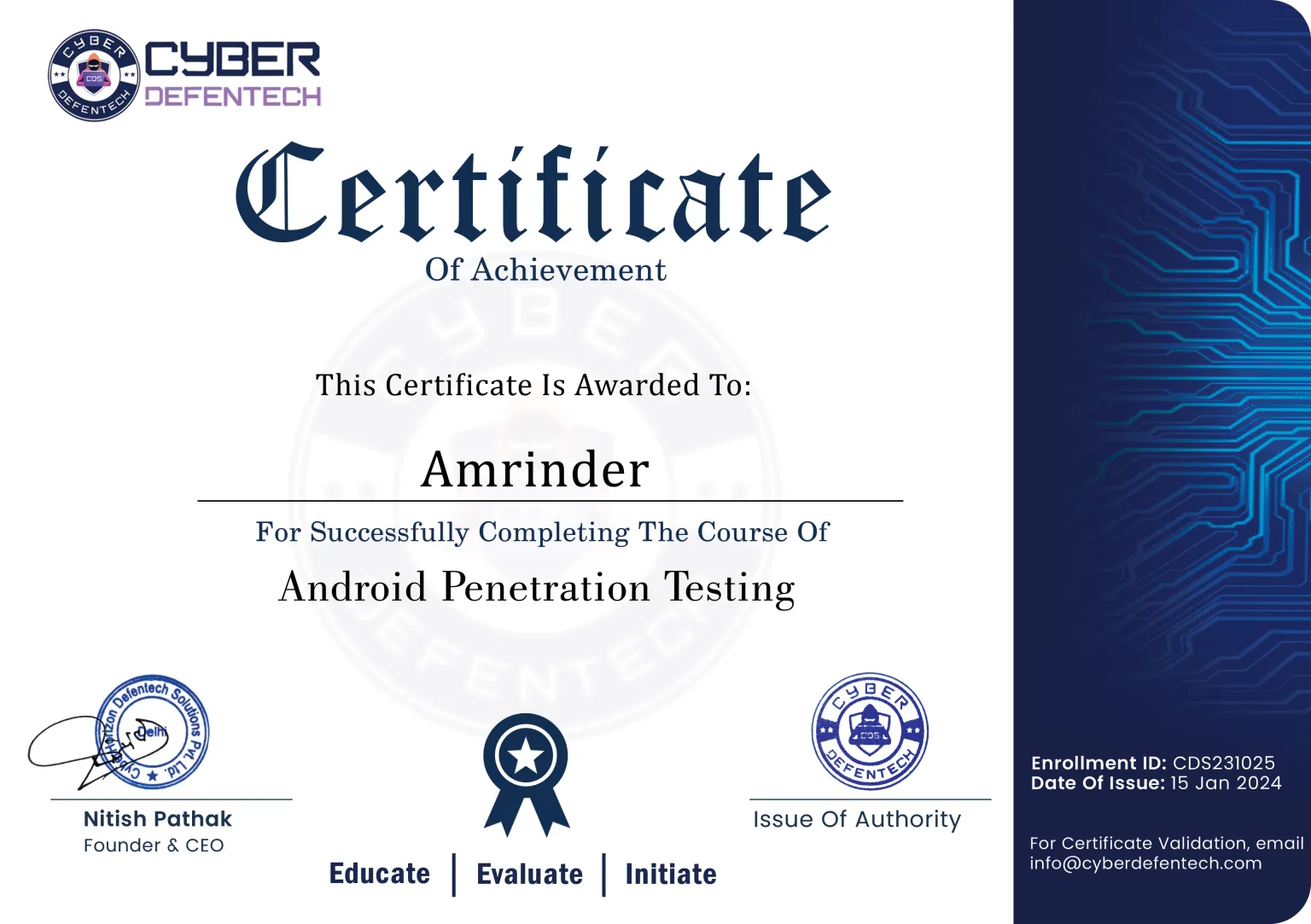




The Oracle Exadata Database Machine: Implementation and Administration course is a specialized training program designed to teach IT professionals how to deploy, manage, and maintain Oracle’s high-performance Exadata Database Machine — a powerful platform optimized for running Oracle Databases efficiently.
To get the most out of this course, students should ideally have: Knowledge of SQL and Oracle Database Basics Understanding database concepts like tables, queries, and data storage. Familiarity with Oracle Database or other RDBMSs (like MySQL or PostgreSQL). Familiarity with Operating Systems (Linux/Unix preferred) Ability to navigate file systems, run basic commands, and manage files. Understanding of Networking Fundamentals Knowledge of IP addresses, switches, storage networking (SAN/NAS), and data transfer basics. Some experience with System Administration (optional but helpful) Exposure to hardware, storage, and clustering concepts will give you an advantage.
🧩 1. Understand Exadata Architecture Learn the components of the Oracle Exadata Database Machine — including database servers, storage servers, InfiniBand networking, and software stack. Understand how Exadata integrates hardware and software for optimal database performance. ⚙️ 2. Implement and Configure Exadata Learn how to install and configure Exadata hardware and software from scratch. Understand initial deployment steps, network setup, and database configuration on the machine. 🗄️ 3. Manage and Monitor Exadata Use Oracle Enterprise Manager and Exadata tools to monitor system performance and health. Learn how to manage resources, check performance bottlenecks, and maintain smooth operations. 🧰 4. Perform Maintenance and Upgrades Learn to apply patches, update firmware, and perform software upgrades. Understand routine maintenance tasks to keep Exadata running efficiently and securely. 🔒 5. Ensure Security and Reliability Learn how to secure data and manage user access on Exadata systems. Understand best practices for backup, recovery, and disaster recovery planning. ⚡ 6. Optimize Database Performance Use Exadata’s unique features like Smart Scan, Smart Flash Cache, and Storage Indexes to boost performance. Learn to analyze workloads and optimize queries for high efficiency. 🧑💻 7. Troubleshoot and Support Identify and resolve hardware, software, and network issues in Exadata environments. Learn diagnostic techniques and use Oracle Support tools effectively.
🧩 Module 1: Introduction to Oracle Exadata Overview of the Oracle Exadata Database Machine Understanding Exadata’s purpose and advantages Key features and capabilities (Smart Scan, Hybrid Columnar Compression, Smart Flash Cache) Exadata architecture overview: Database Servers, Storage Servers, and InfiniBand Network ⚙️ Module 2: Exadata Architecture and Components Detailed study of hardware components (compute nodes, storage cells, networking) Software stack — Oracle Database, Grid Infrastructure, and Exadata Storage Server software Understanding communication flow between servers and storage Concepts of Cell Server, Management Server (MS), and Restart Server (RS) 🧠 Module 3: Initial Configuration and Deployment Installation and configuration of Exadata components Setting up networking and IPs for compute and storage servers Configuring Oracle Clusterware and ASM (Automatic Storage Management) Verifying configuration using Oracle Exadata Deployment Assistant (OEDA) 🗃️ Module 4: Managing Exadata Storage Managing Exadata Storage Cells Understanding cell disks, grid disks, and ASM disks Configuring storage pools and redundancy Using CellCLI and dcli commands for management 🔒 Module 5: Backup and Recovery Best practices for database backup on Exadata Implementing RMAN (Recovery Manager) for backup and restore Understanding disaster recovery using Data Guard Backup strategies using Exadata Snapshots and Flash Cache ⚡ Module 6: Performance Optimization Exadata features for performance improvement Smart Scan Smart Flash Cache Hybrid Columnar Compression (HCC) I/O Resource Management (IORM) for workload prioritization Monitoring and tuning with Enterprise Manager Cloud Control 🧰 Module 7: Maintenance and Patch Management Software and firmware updates Applying patches to Exadata components Managing rolling upgrades for minimal downtime Common maintenance operations and preventive checks 🧑💻 Module 8: Monitoring and Troubleshooting Monitoring tools: CellCLI, DCLI, and Enterprise Manager Common alerts, faults, and logs in Exadata Troubleshooting hardware and software issues Using Oracle Automatic Diagnostic Repository (ADR) 🧾 Module 9: Security and User Management Implementing access controls and privileges Managing users, roles, and authentication Applying encryption and data protection policies Security compliance best practices 🔍 Module 10: Real-World Administration Scenarios End-to-end deployment and administration exercises Performance troubleshooting using real data scenarios Best practices for capacity planning and resource management Preparing for Oracle certification exams related to Exadata
Yes — after completing the Oracle Exadata Database Machine: Implementation and Administration course, you can pursue formal certification from Oracle Corporation
The job market for professionals skilled in Oracle Exadata Database Machine implementation and administration is good but somewhat specialized. Here’s a breakdown of the market dynamics, demand, opportunities and things to keep in mind — particularly relevant if you are in India (since you’re located in Delhi).



 (1) (1).webp)
.webp)
.webp)



 (2).webp)

.webp)
.webp)